

The word ‘cheetah’ conjures images of speed, of spotted flanks, of an elegant tail turning stiff as a counterweight during a chase, of round teddy-bear ears and a tear-streak face. Hear ‘cheetah’ and picture paws pummelling upon the grasslands of Africa. But this cat is not as inherently African as many imagine. One subspecies exists in central Iran, the relic of a population which once spanned from Egypt to India. Go back a few hundred years and Asiatic cheetahs were the fancy of the Arabian and Indian gentry, idolised as symbols of wealth in Middle Eastern and South Asian culture. The very word ‘cheetah’ owes its origins not to European roots, nor to an African tongue, but to the Hindi word chita. Yet they are almost entirely lost from their home continent, with fewer than a hundred survivors scattered over Iran and nowhere else.
For over a decade, experts have explored the possibility of bringing the cheetah back to India. Plans have been considered, announced, celebrated, denounced and resurrected in a tale of turbulent ambition. There are many suggested benefits to the reintroduction, from increased ecotourism to natural control over antelope numbers to rallying conservation efforts for India’s grasslands. But aniticipation is met by complications. Foremost, that as the native Asiatic cheetah teeters precariously over the precipice to extinction, animals would instead have to be sourced from Africa. This is a big, controversial and exciting topic so strap in.

Tasnim News Agency | Wikimedia
Past
Is there such a thing as the Asiatic cheetah? Researchers have spent decades trying to answer this deceptively simple question. There are cheetahs living in Asia, sure, but how they got there and whether they are a unique subspecies is a complicated matter. Body measurements, visual clues and a dab of biogeography are usually all the tools needed to resolve such a crisis of identity but, perhaps suitably, the speedy cheetah is hard to nail down.
The evolutionary history of the cheetah is a tangle. Unpicking the details of its diversification is like taking on that spaghetti of wires gathered in a back drawer over years, neglected because trying to extract any particular cable has never before been a job worth facing. Except in this analogy, several people are pulling cables in different directions. The cheetah’s closest living relatives are the puma and jaguarundi of the Americas but even these are separated from the cheetah by a good 4 – 2 million years. There was an ‘American cheetah’, officially named Miracinonyx, up to the end of the last Ice Age but it is actually more closely related to the puma, its common name just a nod to its convergent body shape and habits. The broad similarity of these animals has tripped up researchers in the past, leading one to sarcastically remark of another’s study that ‘trivial’ popular names are no basis for a taxonomy:
“[The researchers] appear to take the common name of the extinct… ‘American cheetah’ to mean that the species is a close relative of the true cheetah”
This may not sound very cutting in the muted language of scientific reports, but for a taxonomist to accuse another of relying on common names (which often stray from animals’ real relationships) is a bit like accusing a weather reporter of relying on tarot cards to predict the forecast. To evolutionary biologists this is a pretty big burn.
The internal taxonomy of the cheetah is even trickier. A specially-selected crack team of experts officially called the IUCN SSC CSG CCT (that’s the IUCN’s Cat Classification Taskforce) could only conclude of the cheetah that it probably has four subspecies but maybe only two and, if new evidence points that way, there might be none after all. Genetic studies seem to point to four: Acinonyx jubatus jubatus of southern and eastern Africa, A. j. soemmeringii on the inside edge of the Horn of Africa, A. j. hecki in the Sahara Desert and A. j. venaticus of Asia. Some consider cheetahs sandwiched between the southern group of A. j. jubatus and A. j. soemmeringii to be their own subspecies, A. j. raineyi. That’s a lot of italics, so let’s focus down onto the Asiatic animals.
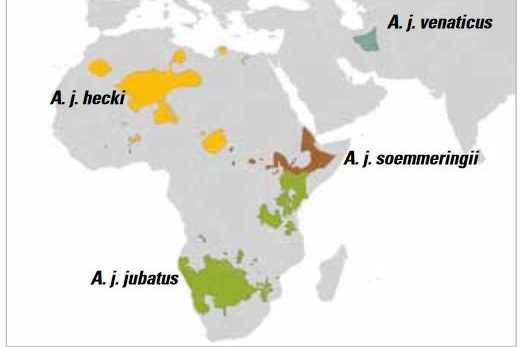
Kitchener et al, 2017
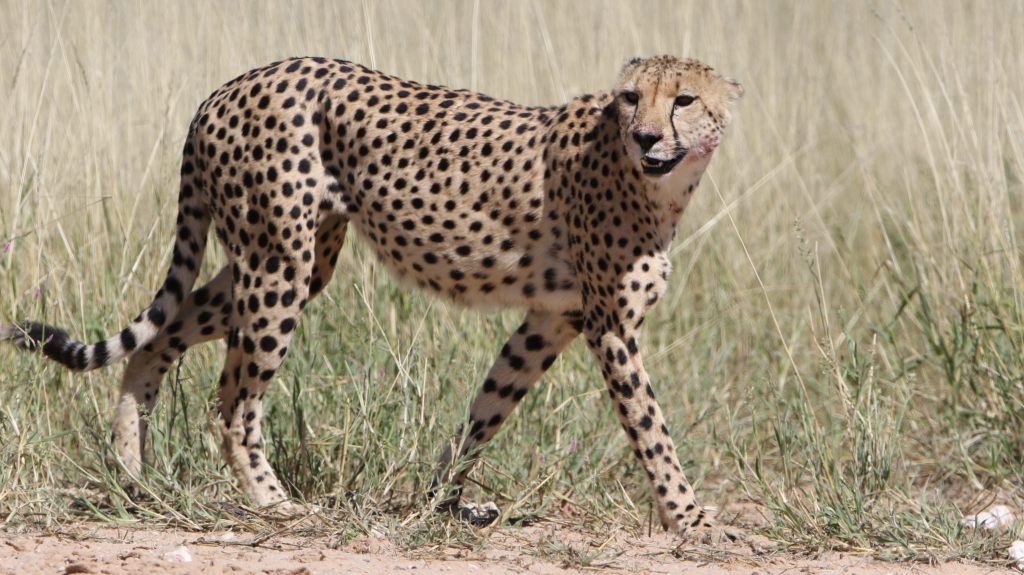
It has been suggested that Asiatic cheetahs are only African cheetahs imported as exotic pets or hunting animals hundreds of years ago; historic records indicate they were certainly brought in from East Africa and antique cheetah specimens from Egypt are similar to those of Asia. However, the great arbiter that is modern genetics debunks the idea these valuable animals were released into the Asian wild en masse and finds that the Egyptian cheetahs, distinct from others in North Africa, were truly Asiatic animals at the very edge of their natural range. Some instead wonder if the Asiatic cheetah diverged too recently from other populations to be distinct, with one important study finding that just 4000 years stand between Asiatic and African animals, not normally enough time for subspecies to arise. This result has since been shot down in a more recent paper by Rai et al which dedicated a long paragraph to explaining, confidently, how the method used had a large degree of error, relied on human rates of evolution which aren’t that accurate if applied to cheetahs and how, if the result was extended into the past, the cheetah and puma species would be much younger than their own fossils. Other studies are more certain of the Asiatic cheetah’s unique status but find a curious relationship to cheetahs in Africa: the Asiatic cheetah is more closely related to the southern African cheetah than to the east African cheetah which sits between them. Quite how this biogeographic leapfrog happened is unclear but the distinction solidifies the Asiatic cheetah as its own subspecies. And this makes it all the more valuable to protect.
Derek Keats | Wikimedia
Asiatic cheetahs once roamed from Egypt through the Middle East and deep into India. They were plentiful, trapped from the wild and kept in their thousands as hunting animals, earning the misnomer ‘coursing leopard’ and confusing historians enormously. Such was the hunger for these cats between the sixteenth and nineteenth centuries that local numbers crumbled and it became easier to ship cheetahs in from East Africa (though as we’ve seen, it’s unlikely African cheetahs made their way into Asia’s wilds). The Asiatic cheetah’s numbers continued to fall as colonialism brought a new trend of trophy hunting and eradication to protect livestock. In an act rendered ridiculous by retrospect, India even placed bounties on its cheetahs, even though modern studies show they will steer clear of livestock wherever there is enough wild prey. By the 1940s, the Asiatic cheetah’s global population had fallen to 400 individuals and three decades later they were lost from India. Only by this point had conservation work begun but this was an uphill battle, the 1970s notably the worst decade for cheetah losses. An inexorable decline continued until the cheetah was gone from the Arabian Peninsula, Pakistan, Iraq, Turkmenistan and Afghanistan. Today, between 100 and 40 Asiatic cheetah are left, scattered across a few protected areas in Iran.
Present
The Asiatic cheetah is now confined to a handful of protected areas in central Iran. Critically dilute, their modern extent represents 23% of their natural range but with perhaps less than 1% of their natural population. Their more vagrant modern ecology is a symptom of their poor-quality habitat, as they hang on only in desert with their preferred gazelle prey replaced by livestock. Forced to take whatever they can find, their diets now rely heavily on sheep and goats, as well as hares and other small prey normally off the menu.
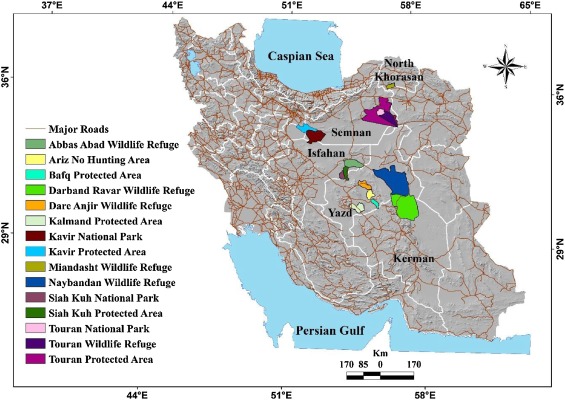
Mohammidi et al, 2018
One of the most often-reported threats to the cheetah, in both Iran and Africa, is genetic loss. After African cheetah numbers had been brought dangerously low, they were found to breed very poorly in zoos, producing unhealthy animals. This was seen as a crisis for the whole cheetah species, an irreversible ratchet towards extinction, making cheetahs a textbook example of an animal doomed by low genetic diversity. More recent practices have replaced this picture, achieveing success in breeding programs and bolstering the African population. Even more promisingly, modern genetic evidence shows that cheetahs have survived two natural population crashes in the last 100 000 years and were still going strong until recently, demonstrating how resilient this species can be even when faced with a shrunken genepool. However, while this is good news for the cheetah as a whole, the Asiatic subspecies remains in dire trouble – their numbers are probably lower than they have ever been and they remain threatened by poaching, road collisions and lack of prey. The subspecies is hurtling towards extinction, with 41 animals found dead between 2001 and 2012, not including unreported deaths. Ten years on and there may not even be 40 animals left. The Iranian Cheetah Society has stated in their 2019-2020 Biannual Report that records of breeding in the last year were restricted to only a couple of families in a single reserve. The Society cites this rare sighting as cause for hope, but even they are shifting focus to ex-situ conservation through breeding and release programs. It’s difficult to remain optimistic for the survival of the subspecies. With such fragility, removing any cheetahs for introduction to India would mean removing a sizeable chunk of the remaining population, a move too risky to consider and one which the Iranian government has already ruled out. (As an alternative source of the cats, one research team attempted to clone and grow Asiatic cheetah embryos from frozen tissues. It was an ambitious project but came to naught.)
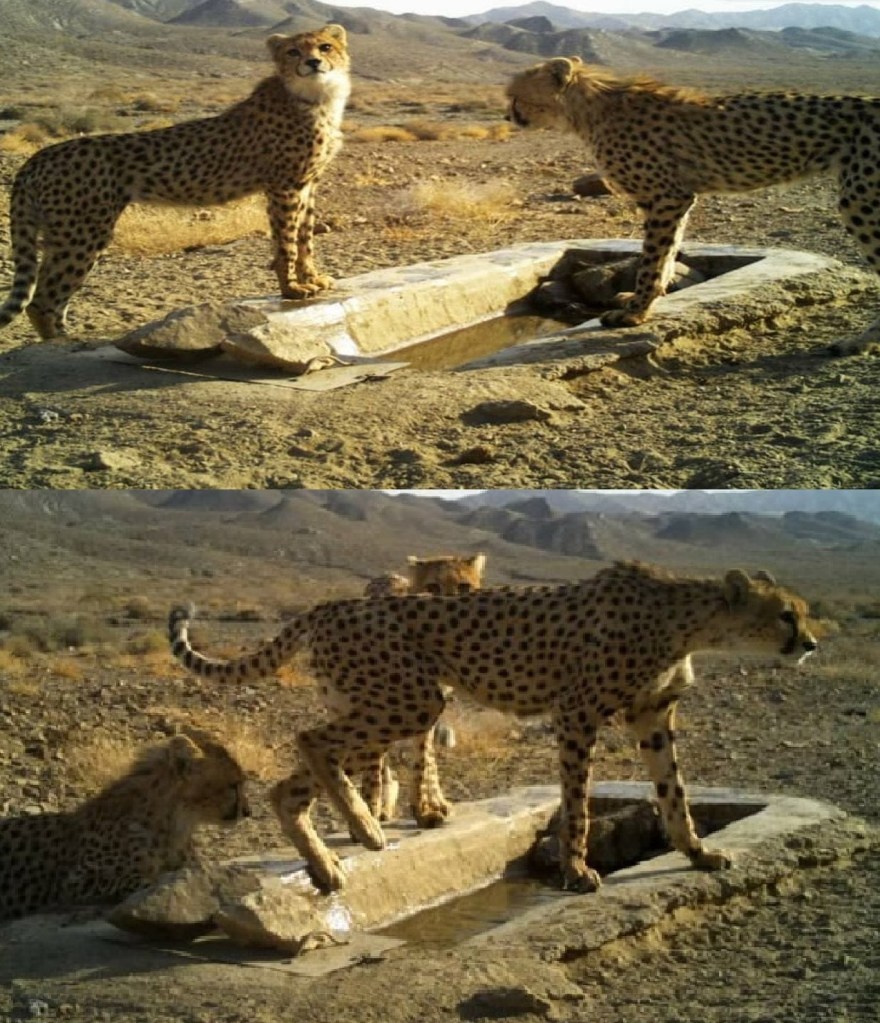
Iran Front Page News
Meanwhile, the Indian grasslands are without their cheetah. These ecosystems have historically been treated as little more than wasteland, to be paved over with industry or dug and forested. Even well-meaning conservation projects call for the destruction of these natural plains for the sake of unnatural woodland. One quoted benefit of bringing cheetah back to India is that it could incentivise major restoration in order to make a home for the cats. It could work in the same way that the promise of new tenants causes a house to be refurbished, not because the tenants fix the hole in the floor or update the plumbing but because their impending arrival provides incentive for these things to be done. And just as tenants clean and maintain the house they’ve moved into, the cheetah can help maintain its ecosystem by controlling the populations of prey species. The cheetah will even pay its way, drawing in tourist revenue. I have to wonder though, between rhinos and tigers and houbara and gharials and elephants and lions all providing cause for conservation, will another big, charismatic animal really make the difference?
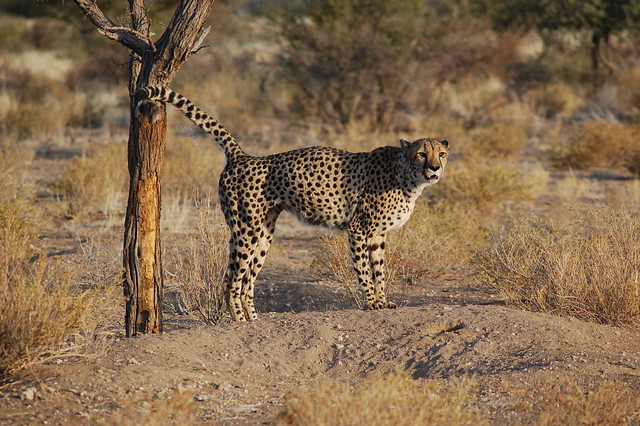
And what of the African cheetah itself? There are around 7000 in the wild currently, the majority being the southern African subspecies (the most likely candidate for export to India). Other populations are dangerously low, with for example 300 or so wild animals residing in the Horn of Africa. There are arguments, then, that a population in India could serve as insurance against any plight faced by the species elsewhere. It is not beyond imagining that cheetahs in India might some day be sent back to Africa to bolster numbers there.
Future
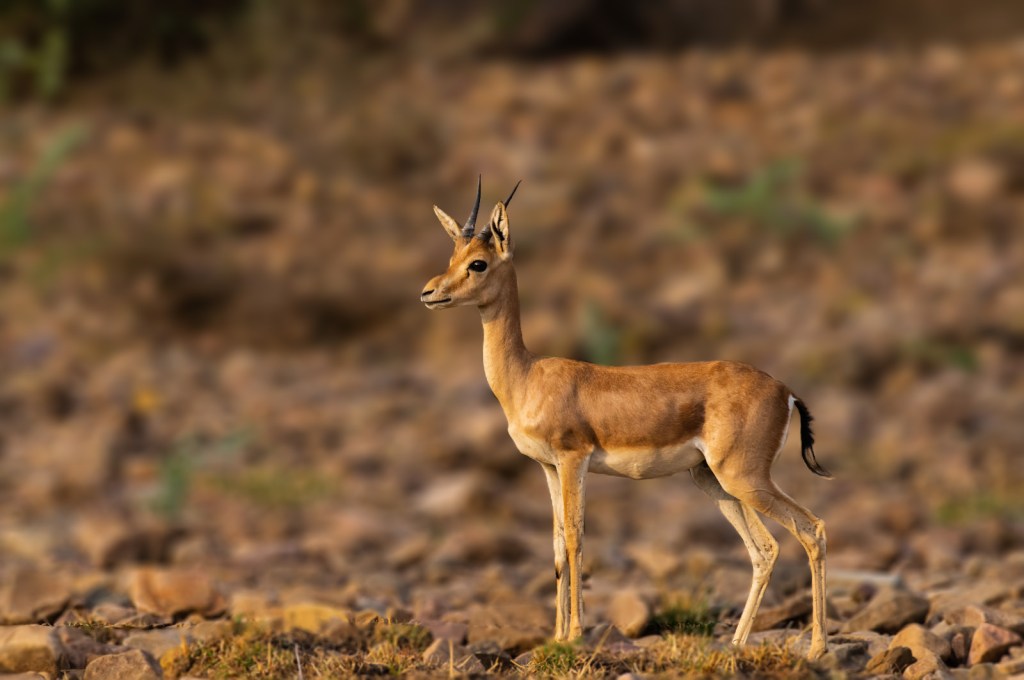
In 2010, an official report on the potential for African cheetah introduction to India was published. It selected three areas as most suitable and suggested 30 animals be released into each, expanding beyond those borders to a population of nearly 200. The report stresses very honestly that big changes would need to be made to accommodate the cats, which require large areas of suitable habitat, a reliable prey base (chinkara gazelle are the native Asiatic cheetah’s preferred snack) and a restricted human presence. These preparations have been largely made in Kuno-Palpur already, in anticipation of Asiatic lions which never arrived.
Apoorv Karlekar | Wikimedia
Just two years later, a court found the plans to be unsuitable because they had not been passed by the National Board for Wildlife, study was insufficient, certain legal standards were contravened and the Asiatic lion introduction project took priority. Shahabuddin wrote a brilliant reflection on all the ways the 2010 report fell apart: the survey methods were poor, different prey species were lumped together haphazardly in the statistics, bothed relocation of people in Kuno-Palpur had set a precedent of leaving them on poor-quality land with no financial support, and the report severely underestimates the area requirements for cheetah. This conclusion would be reviewed under petition and overturned but it had already cemented doubt in some experts, so the introduction was swallowed up in controversy and never came to anything.
Until this year, and those old gears have begun to turn again. A new technical document from the Wildlife Institute of India has recently re-assessed those sites from the 2010 plan using better methods. The document reiterates much of the content of the old plan, pushing Kuno as the soonest option for wild Indian cheetahs. It also suggests Mukandara Hills Tiger Reserve, Shergarh Wildlife Sanctuary and Gandhi Sagar Wildlife Sanctuary as the next best locations, each requiring work and able to support only a few cheetah but near enough to one another to serve as a single meta-population. There is a great deal of preparation needed before India’s reserves are ready for wild cheetah again, but things are certainly in motion. It’s generally believed southern African cheetah will adapt well to India’s grasslands, that their ecologies and habitats are similar enough for the transition to be smooth. Some remain cautious about the move though, insisting that not enough is known about India’s grassland ecosystems or about the role of the Asiatic cheetahs which are being replaced. Perhaps the program will give people, locally and internationally, a greater respect for India’s wild grasslands and a greater need to understand them, since the plan for the cheetah’s return has made the rounds in global news every time it’s been given the go-ahead. I still worried, though, that cheetah will have no more impact than the other large, famous animals I mentioned – the whole ecosystem is woefully overlooked and I’m sceptical that cheetah will make a sudden difference. There’s no denying India’s natural heritage deserves more attention than it gets. I just wish there was a more public push for the endangered species already there.
Joachim Huber | Flickr
Even besides all of this, there is an (Asian) elephant in the room: the wild Asiatic cheetah still roaming the shrublands of Iran. Perhaps I am overly optimistic, since there seems only a small window for recovery and it is closing fast, but importing African cheetahs to fill the role of Asiatic ones feels like giving up on the native subspecies. With southern African animals established in Asia, there will be less incentive to push for the survival of the Iranian cheetahs and they will surely be left to fade. Or, should Asiatic cheetahs ever recover, they’ll come up against the established African animals in India. In fact, if the introduced subspecies’ population expands faster than the cheetahs of Iran, they may mix and swamp the native animals. To bring African cheetah to India seems to threaten doom for the Asiatic cheetah, if it isn’t doomed already. I myself am not against the ultimate release of African cheetah into India, but I believe that after nearly a century of struggle the native, unique Asiatic cheetah shouldn’t be written off and replaced just yet.
References
Agoramoorthy G & Vijay Kumar V. 2011. Reintroducing the cheetah to India’s grassland – glamour or conservation?, Current Science, 101(3), pp. 261-262
Charruau P, Fernandes C, Orozco-terWengel P, Peters J, Hunter L, Ziaie H, Jourabchian A, Jowkar H, Schaller G, Ostrowki S, Vercammen P, Grange T, Schlötterer, Kotze A, Geigl E-M, Walzer C & Burger PA. 2011. Phylogeography, genetic structure and population divergence time of cheetahs in Africa and Asia: evidence for long-term geographic isolates, Molecular Ecology, 20(4), pp. 706-724
Durant S, Mitchell N, Ipavec A & Groom R. 2015. Acinonyx jubatus. The IUCN Red List of Threatened Species 2015: e.T219A50649567. Available at: https://dx.doi.org/10.2305/IUCN.UK.2015-4.RLTS.T219A50649567.en. Retrieved: 05/09/2021
Farhadinia MS, Hosseini-Zavarei F, Nezami B, Harati H, Absalan H, Fabiano E & Marker L. 2012. Feeding ecology of the Asiatic cheetah Acinonyx jubatus venaticus in low prey habitats in northeastern Iran: implications for effective conservation, Journal of Arid Environments, 87. 206-211
Farhadinia MS, Hunter LTB, Jourabchian A, Hosseini-Zavarei F, Akbari H, Ziaie H, Schaller GB & Jowkar H. 2017. The critically endangered Asiatic cheetah Acinonyx jubatus venaticus in Iran: a review of recent distribution, and conservation status, Biodiversity Conservation, 26, pp. 1027-1046
Faurby S, Werdelin L & Svenning JS. 2016. The difference between trivial and scientific names: there were never any true cheetahs in North America, Genome Biology, 17: 89
Iranian Cheetah Society. 2021. 2019-2020 Biannual Report
Jhala YV, Bipin CM, Jhala HY, Yadav SR & Chauhan JS. 2021. Assessment of cheetah introduction sites and proposed actions. Technical note. Wildlife Institute of India, Forest Department of Rajasthan and Forest Department of Madhya Pradesh
Johnson WE, Eizirik E, Pecon-Slattery J, Murphy WJ, Antunes A, Teeling E & O’Brien SJ. 2006. The late Miocene radiation of modern Felidae: a genetic reassessment, Science, 311(5757), pp. 73-77
Khalatbari L, Yusefi GH, Martínez-Freiría F, Jowkar H & Brito JC. 2018. Availability of prey and natural habitats are related with temporal dynamics in range and habitat suitability for Asiatic cheetah, Hystrix, 29(1), pp. 145-151
Kitchener AC, Breitenmoser-Würsten Ch, Eizirik E, Gentry A, Werdelin L, Wilting A, Yamaguchi N, Abramov AV, Christiansen P, Driscoll C, Duckworth JW, Johnson W, Luo S-J, Meijaard E, O’Donoghue P, Sanderson J, Seymour K, Bruford M, Groves C, Hoffmann M, Nowell K, Timmons Z & Tobe S. 2017. A revised taxonomy of the Felidae. The final report of the Cat Classification Task Force of the IUCN/SSC Cat Specialist Group. Cat News Special Issue, 11
Mohammadi A, Almasieh K, Clevenger AP, Fatemizadeh F, Rezaei A, Jowkar H & Kaboli M. 2018. Road expansion: a challenge to conservation of mammals, with particular emphasis on the endangered Asiatic cheetah in Iran, Journal for Nature Conservation, 43, pp. 8-18
Moqanaki EM & Cushman SA. 2017. All roads lead to Iran: predicting landscape connectivity of the last stronghold for the critically endangered Asiatic cheetah, Animal Conservation, 20, pp. 29-41
Moulavi F, Hosseini SM, Tanhaie-Vash N, Ostadhosseini S, Hosseini SH, Hajinasrollah M, M, Asghari MH, Gourabi H, Shahverdi A, Vosough AD & Nasr-Sfahani MH. 2017. Interspecies somatic cell nuclear transfer in Asiatic cheetah using nuclei derived from post-mortem frozen tissue in absence of cryo-protectant and in vitro matured domestic cat oocytes, Theriogenology, 90, pp. 197-203
O’Brien SJ, Johnson WF, Driscoll CA, Dobrynin P & Marker I. 2017. Conservation genetics of the cheetah: lessons learned and new opportunities, Journal of Heredity, 108(6), pp. 671-677
Paul MM & Vanak AT. 2020. India’s savanna grasslands: the unsung tale, Conservation India, available from: https://www.conservationindia.org/articles/indias-savanna-grasslands-the-unsung-tale. Accessed 01/11/2021
Rai N, Verma SK, Gaur A, Iliescu FM, Thakur M, Golla TR, Chandra K, Prakash S, Tabasum W, Ara S, Singh L, Thangaraj K & Jacobs GS. 2020. Ancient mtDNA from the extinct Indian cheetah supports unexpectedly deep divergence from African cheetahs, 10, 4618
Rankitsinh M & Jhala Y. Assessing the potential for reintroducing the cheetah in India. Wildlife Trust of India, Noida & Wildlife Institute of India, Dehradun TR 2010/001 (2010).
Shahabuddin G. 2015. Reclaiming the grassland for the cheetah: science and nature conservation in India, CASI Working Paper Series, 15-03
Thapar V, Thapar R & Ansari Y. Exotic aliens: the lion and the cheetah in India, Aleph, New Delhi, 2013. ISBN 9789382277552 in Packer C. 2013. Is India’s pride actually African?, Science, 340, pp. 1289-1290

