
We may awe at the elephant, fear the leopard, be transfixed by the butterfly and celebrate the kingfisher, but none of these species define their habitats as strongly as the trees they live amongst. Wherever present, the density, height, soil impact and species composition of a tree community allow the denizens of that habitat to thrive. Some rely on the shade or the vertical complexity or the leaf litter trees provide, others burrow between their roots or under bark, others still swallow their fruits or roost amongst their branches. Trees, ancient and massive, shape a landscape and its ecology more than any other organisms, so when an invasive tree dominates a new environment, the results can get interesting.
Evolved in tropical Africa, the tulip tree (Spathodea campanulata) is sought after by horticulturalists the world over for its easy cultivation, rapid growth, cool shade and lipstick-red flowers. Unfortunately, such features (including the allure to global gardeners) prove an effective arsenal for invading tropical islands. So voracious is this plant, and so stubbornly does it defy extermination, that this fancy garden favourite lands in 88th place on the IUCN’s 100 Global Worst Invasive Species. Nowhere else has this perilous plant taken over than in Puerto Rico, where it is now the most abundant tree species. But in the right place, the tree’s remarkable propagation powers can be used for good: taking fantastically to open fields, it can transform abandoned farmland into rich forest. In a crowded world just beginning to embrace rewilding, does their guerilla succession redeem the African tulip tree, or can they cause more problems than they solve?

TR Shankar Raman | WikiMedia
Past
Before European colonisation, Puerto Rico was a densely-forested jewel of the Caribbean wilds, but industriousness hit the island hard and reduced its forest cover to just 5% by the mid-20th Century. Sugarcane, coffee, tobacco, plantains and livestock made up the bulk of agriculture, with subsistence farming claiming a good portion of natural land too. Changes in the territory’s economy have since lead to land abandonment, and half of the island by area had reforested itself as of the year 2000: a remarkable recovery.
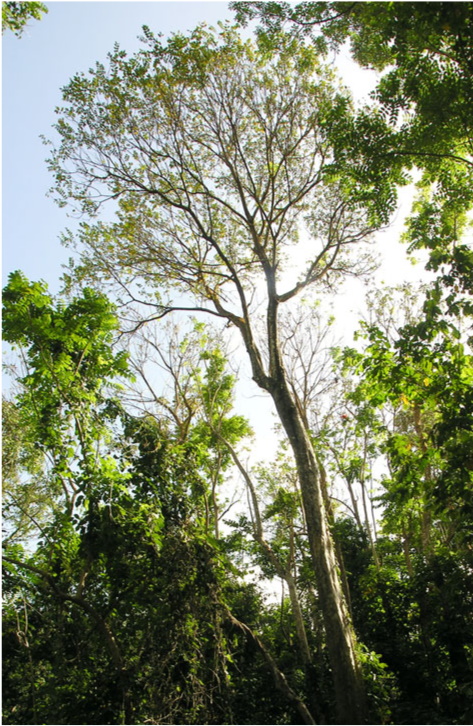
The African tulip tree is a native of central and west Africa, straddling the equator from 12oN to 12oS. It has a tall trunk with high-bifurcating branches and dense, irregular canopy crowns 20-30m up. Unrelated to tulips, the name comes from its flaming red flowers which contrast strongly against its dark foliage, shaped like those of a tulip. Birds and bats share in pollination effort, leading to the growth of long, brown seed pods each of which disseminates some 500 seeds. These float on the breeze through the tree’s native habitats: either open savannah forests, or secondary forest where this pioneer has already achieved succession.

H Zell | WikiMedia
As well as mainland nations such as Thailand and Costa Rica, the tulip tree has been introduced to tropical islands such as Fiji, New Guinea, Sri Lanka and Hawaii. It has often been planted alongside coffee and sugarcane to provide shade or a windbreak, but also serves an ornamental purpose in tropical gardens. Their circum-equatorial existence is a tribute to their rapid growth and ease of cultivation: it is through these features that the tree finds itself in the open enclosures of gardens or fields, and is able to run riot once escaped. Since its first arrival in Puerto Rico, the African tulip tree has risen quickly from curiosity to mainstay and rapid converter of farmland to woodland.

mauro hepbern | Flickr
Present
African tulip trees are swallowing Puerto Rican farmland abandoned under the nation’s switch to an oil-based economy. The trees grow well in rough, damp lowland terrain, be that old agricultural land, deforested areas and in some secondary rainforest, so were quick to spread as the highly managed lands grew feral. They propagate both by seed and by runners, establishing stands of 40 trees per hectare usually, but reaching densities of 120 trees per hectare; their seeds can germinate with a success rate of 80%, a staggering figure when each tree releases thousands every year. Today, the African tulip tree is Puerto Rico’s most abundant tree and dominates moist secondary rainforest there, having lead the charge of trees into pasture.
The novel forests are more densely vegetated than other woodlands on the island, the tulip trees themselves standing both broader and taller than native species. Between these grow a unique mix of cultivated remnants: grapefruit, plantain and coffee mix with palaeotropical kassod, flamboyant, country almond and white siris. A host of bird species spread their seeds, ensuring these former crops and ornamentals extend beyond their origins. But antagonistically, native trees travel on those same borrowed wings. As alien as these forests are, resident species can infiltrate in the bellies of birds, depositing propagules in droppings. So alongside the tulip trees grow Puerto Rican royal palm, West Indian ironwood, white pricklyash, fellow pasture pioneer Cecropia and Puerto Rico’s recently chosen national flower, the maga.
Indeed, the invasive African tulip tree is in some ways a blessing for near-barren Puerto Rican fields: it takes to abandoned pasture so well that it makes an efficient pioneer species for establishing forest habitat. Maintaining itself as the dominant canopy tree for 50 years or so, the tulip trees allow a complex understorey to develop, restabilising and replenishing the soil so that native species can infiltrate the novel forests from isolated relicts and take pride of place again. The whole process is an ecological slingshot of succession from empty pasture to subtropical forest. Better still, African tulip trees are not shade tolerant: as they grow tall and spread their branches, so they shade out their own progeny and exterminate themselves. They are seemingly the perfect force for reforestation. But then they wouldn’t place 88th on the IUCN’s Most Invasive Species list.
The clearest invasive impact of the African tulip tree is that same doggedness that makes it an effective pasture pioneer; if anything, it is too effective. The tree takes hold of fields with such vivacity, and is so difficult to remove, that farmers often abandon inundated land and cut out new swathes from the surrounding native forest. In the face of costly pest control, clearing the forest is preferable, showing the unexpected chain links that can make an agricultural and economic pest into an environmental one. That abandoned forest patch will be slowly be colonised by a range of species, but it replaces the far more mature, complex, pre-existing habitat. The freaky foreign forests are less supportive of rare native species than the original habitat with which those species evolved. Once established, the tulip trees have a stranglehold on their environment and regrow with a fervour. Costly application of strong herbicides to stumps is the only known effective control method and while biological controls are being tested, they must match the Puerto Rican tree population to be most effective, and this requires knowing where the Puerto Rican plants came from. And the African tulip tree isn’t even the only succession pioneer on the island; native species, like the Cecropia I mentioned earlier, may take longer to establish on barren fields but can do the job just as well without disrupting the local ecology or getting too comfortable on profitable farmland.
The African tulip tree is like the worst kind of friend: the one you think is helpful and supportive only for them to barge their way to being the centre of attention, always crash on your sofa, rifle through your fridge without asking, never take the hint when you want them to leave and then invite themselves to your neighbours’ parties.
Lugo & Helmer, 2004.
Future
If the African tulip tree is self-extirminating, this problem will solve itself, right? Well, no. Firstly, wherever there is farmland, there will be space for the voracious plant to invade. Secondly, although it grows poorly in shade, some degree of successful seeding in secondary forest suggests this species can persist for unexpectedly long. And with thousands of wind-blown seeds dispersed by each tree every year, there only have to be a few survivors to maintain the population each generation. This allows the tree to stubbornly hold out in wetter, lower-nutrient, alluvial soils where other plants of its size would struggle. With eradication so costly and difficult, land abandonment so common and a good area of forest recovered (even if it is young and full of the wrong species), tackling tulip trees may not be a high priority for the Puerto Rican government. Unfortunately, the wood is low quality and used mainly for fenceposts, if at all, so a selective mass harvest would bring little in immediate profit.
As for the forests as a whole, they are destined to remain a mix of native and introduced species, a cosmopolitan microcosm. There is already such a variety, defined both by the agricultural history of the land and its natural history beyond that, that to remove all invasive species would be to remove much of the forest cover altogether. Indeed, Abelleira Martínez and her colleagues have suggested in a couple of papers (Martínez, 2010; Martínez et al, 2010) that leaving the tulip trees in place is preferable to uprooting the now-established forest. However, there is good news in the finding that the composition of the weird tulip tree forests trend towards increasing representation of native species over time: natives are recolonising their lost territory, if not completely outing the invaders. Also, being mostly a grassland pioneer species, the tulip trees have only limited capacity (though more than none) to take hold in Puerto Rico’s older, unsullied woodlands. It seems, then, that the foreigners’ presence and impact will dilute with time but never disappear. And if agriculture bounces back in Puerto Rico, the tulip trees will continue to force farmers to fell old forests.
Looking off into the evolutionary distance, as I like to, it seems Puerto Rico will always host a new habitat. The introduced species will grow rarer as native trees recover and the real estate of empty fields disappears, but African tulip trees and other agricultural hangovers seem to have found some place for themselves on this Caribbean island. I imagine tulip trees will be pushed out to low-competition fringes for the most part but, already being the tallest tree around and relying on wind for seed dispersal, perhaps there will only be more pressure for their propagules to reach further, and for the trees to reach yet higher over the canopy, a tangle of weird, wrong-continent agricultural relics somewhere below.
References
Abelleira Martínez OJ. 2010. Invasion by native tree species prevents biotic homogenisation in novel forests of Puerto Rico, Plant Ecology, 211, pp. 49-64
Abelleira Martínez OJ, Rodríguez MA, Rosario I, Soto N, López A & Lugo AE. 2010. Structure and species composition of novel forests dominated by an introduced species in northcentral Puerto Rico, New Forests, 39, pp. 1-18
Brandeis TJ, Helmer EH, Marcano-Vega H & Lugo AE. 2009. Climate shapes the novel plant communities that form after deforestation in Puerto Rico and the UK Virgin Islands, Forest Ecology and Management, 258, pp. 1704-1718
Brown P & Daigneult A. 2014. Cost-benefit analysis of managing the invasive African tulip tree (Spathodea campanulata) in the Pacific, Environmental Science & Policy, 39, pp. 65-76
CABI. 2019. Spathodea campanulata: Invasive Species Compendium. Wallingford, UK. Retrieved from http://www.cabi.org/isc/datasheet/51139, accessed on 25/06/2021.
Global Invasive Species Database. 2021. 100 of the World’s Worst Invasive Alien Species. Retrieved from http://www.iucngisd.org/gisd/100_worst.php, accessed on 16/03/2021
Labrada R & Medina AD. 2009. The invasiveness of the African tulip tree, Spathodea campanulata Beauv., Biodiversity, 10, pp. 79-82
Larrue S, Daebler C, Vautier F & Bufford JL. (2014). Forest invasion by the African tulip tree (Spathodea campanulata) in the Hawaiian islands: are seedling shade-tolerant?, Pacific Science, 68(3), pp. 345-358
Lugo AE, Abelleira OJ, Collado A, Viera CA, Santiago C, Vélez DO, Soto E, Amaro G, Charón G, Colón H Jr., Santana J, Morales JL, Rivera K, Ortiz L, Rivera L, Maldonado M, Rivera N, Vázquez NJ. 2011. Allometry, biomass, and chemical content of Novel African Tulip Tree (Spathodea ampanulata) forests in Puerto Rico, New Forests, 42, pp. 267-283 | Note: Took place at a volcanic substrate site; surveyed trees were hurricane survivors
Lugo AE & Helmer E. 2004. Emerging forests on abandoned land: Puerto Rico’s new forests, Forest Ecology and Management, 190, pp. 145-161
Martínez Abeleira OJ. 2011. Flooding and profuse flowering result in high litterfall in novel Spathodea campanulata forests in northern Puerto Rico, Ecosphere, 2(9), 105
Sutton GF, Paterson ID & Paynter Q. 2017. Genetic matching of invasive populations of the African tulip tree, Spathodea campanulata Beauv. (Bignoniaceae), to their native distribution: maximising the likelihood of selecting host-compatible biological control agents, Biological Control, 114, pp. 167-175
Wilkinson DM. 2004. The parable of Green Mountain: Ascension Island, ecosystem construction and ecological fitting, Journal of Biogeography, 31, pp. 1-4
 Novel Ecology