

The mountain pygmy-possum (Burramys parvus) is a tiny marsupial no bigger than your palm. They are the only Australian marsupial to naturally hibernate, the females chasing the males out of the best territories in an admirable display of female empowerment. Restricted to just a few specks in the Southern Alps and with climate change looming, these possums are at the height of danger with a mountain to climb. There’s nowhere to go but up – except on a mountain top there’s no more ‘up’ to go to. One proposal argues for a major move which could give the pygmy-possums a future by mirroring the past. They use fossil evidence to show that this species once thrived in a very different environment and perhaps could do so again. Is the mountain pygmy-possum past its peak or is there a future for it yet?

Image: Business Insider
Past
The mountain pygmy-possum was first described not from living specimens nor dusty museum furs. It is one of those few but fascinating examples of a modern species discovered from prehistoric fossils. Found in 1895, these date the species back to the Pleistocene when rainforests lapped at the mountains. Today the mountain pygmy-possum is found only above the snowline, a situation unique amongst Australian mammals, but this masks a fascinating prehistory which turns modern understanding of this species on its head.
The Burramys genus, in which the mountain pygmy-possum is the only living member, reaches back some 25 million years. All three prehistoric members of the genus lived in wet lowlands, whether 25 million, 13 million or 4.3 million years ago (B. wakefieldi, B. brutyi and B. triradiatus respectively). The contemporary Burramys parvus species is the only one known to have ever lived in alpine habitat but recent fossils from a cooler time suggest even it once roamed woodland at much lower altitudes than today, alongside more typical forest species like sugar gliders. Fossils have been found from 280m above sea level, whilst today none are found below 1225m.
So if mountain pygmy-possums, like their ancestors, once lived among the trees lower down the slopes, how did they wind up stuck in the snow? Ironically, the mountain pygmy-possum has come to rely on snow for survival. They hibernate during the winter, when food is scarcer. As climates cooled during glacial periods, the woodland receded and the possums became stranded on their mountains. They survived hiding in the crags and tunnels of boulderfields, the snow adding an insulating layer in the coldest months. As the last glacial maximum passed, temperatures warmed enough for snow cover to thin in the valleys, lasting for fewer and fewer weeks, rendering the valleys unsuitable for the possums whilst only the peaks stayed cold enough for the snow not to thaw until Spring. This juxtaposition, needing cold to bring snow to protect from cold, restricts the pygmy-possums from spreading back to their former woodland home.
Present
Only four populations of mountain pygmy-possum are known today, all in the Southern Alps near the New South Wales-Victoria state border. They hang on in Mount Murray National Park, the Bogong High Plains and the north and south ends of the Kosciuszko National Park. The Mount Buller population was discovered in 1996 and the northern Kosciuszko animals in 2010, a testament to the reclusiveness of this animal. These areas sum together to give a total known range of 7km2, and that’s all. They are classed as Critically Endangered by the IUCN for good reason.
The tiny marsupials are highly reliant on Bogong moths and reanimate from their hibernation just in time to feast on them. These moths make up some 30-50% of mountain pygmy-possum diets in the Spring so are critical for their survival. Also of huge importance is the mountain plum-pine, a shrubby cold-resistant tree bearing fruit and seeds on which the possums feed. These species are ecologically tied together: with Bogong moth populations falling in recent years and plum-pines pressured by wildfires (the latter were wiped out from the northern Kosciuszko site in 2007), the mountain pygmy-possum is losing its food source.
The wider and even less forgiving issue faced by the possums is that of global warming. Mountain pygmy-possums rely on snow cover as insulation from the coldest cold. However, climate change is reducing the amount of snowfall and shortening the period in which snow covers the ground. The most dangerous time for the pygmy-possums is directly after snow melt, while temperatures are still low. The pygmy-possums’ hibernacula must remain around 2oC – any cooler and they need to wake and expend energy to keep themselves warm. Snow cover goes a long way to maintaining a steady temperature and without it the elements get in. As the climate warms, the snow line creeps to higher and higher elevations until it exceeds the mountain peak. There’s no way out for the possums.
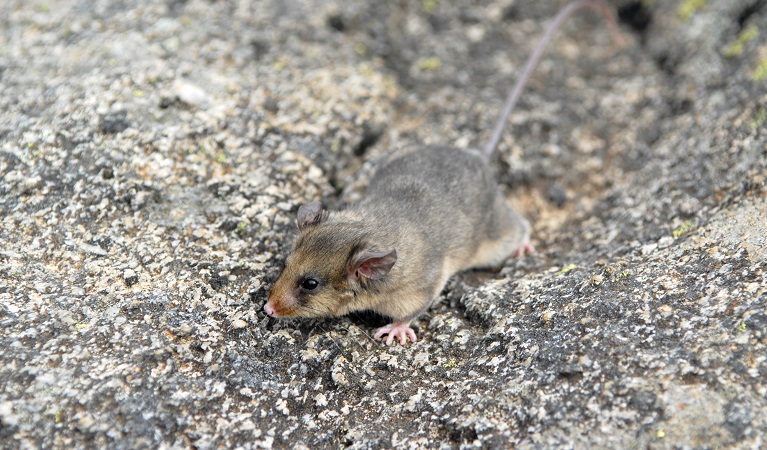
Image: NSW National Parks and Wildlife Service
The northern Kosciuszko population provides a glimmer of hope. Found at a slightly lower altitude than other populations, it lies outside of the area first thought habitable for them. These small adventurers rely on cooler south-facing climbs where snowfall is greater for longer. They also get along better – females here are more tolerable of other females and of males, forcing fewer animals into inhospitable territory. Better yet, these animals show a broader diet with less reliance on Bogong moths. This recently-discovered population suggests that there may be more animals out there than currently thought, living in a greater range of conditions than believed possible. On the other hand, it goes to show how little we know of the mountain pygmy-possum and how much we need to learn to protect them effectively.
Future
With accelerated modern climate warming, the snowline is rising rapidly towards the pygmy-possums. They have nowhere to climb to – the little mountaineers are already found near the peak of the Australian mainland’s highest point. Even above the snow line, climate change brings more common temperature extremes and a shorter period of snow cover on the ground, meaning more wakes from hibernation, more energy spent on keeping warm and either hypothermia or starvation. All this even if they survive the threats of tourism development and food species disappearance.
Even if there are as yet undiscovered populations, they will still the same threats. The difference is they would be snuffed out unnoticed, without protections in place.
Things look pretty grim. But there are the whispers of a plan. First of all, programs are already in place to reintroduce captive-bred animals to the mountains, with the dual intent to bolster existing populations and bring in greater genetic diversity. This has been controversial, since animals of different populations were mixed despite having evolved separately for hundreds of thousands of years, but it reduces the risk of inbreeding effects and the dreaded extinction vortex.
Hawke et al (2019) also suggest, if fleetingly, that pygmy-possums could be captured, bred and released in new locations which would remain or become suitable even as the climate warms (a strategy called assisted migration). There are no taller peaks to take them to, but that oddball northern Kosciuszko population indicates that the right mountainsides might do it without needing to be the very highest.
But there is a far grander plan being put together. As I said, the mountain pygmy-possum once lived in lower woodlands much like its prehistoric ancestors. Archer et al (2019) outline what they call the Burramys Project, a one-of-a-kind plan to breed and release mountain pygmy-possums in wooded wet lowland sites: the kind of habitat this species once occupied but where is no longer found. The argument is that the pygmy-possums have become trapped in their snowy refugia, holding on in the very extreme of their tolerance with no way back to their true original home. With climate change erasing those refuges, the researchers argue that there may be no other way to keep the species going. Observations of living animals will tell you that the mountain pygmy-possum is an alpine specialist. But Archer et al refer to the fossil record and, pointing also to animals in captivity which live happily in warmer temperatures, make a point that the mountain pygmy-possum can live happily away from the mountains. The animals must remain under 28oC to avoid overheating but this demand is met by some lowland woodlands and can otherwise be found in boulder shelters that currently keep mountain pygmy-possums warm in the deep midwinter. They even hibernate for shorter periods when food is more reliable and temperatures are more stable, suggesting their modern range only represents the very edge of what they can survive. The Burramys Project is only an idea so far and research is needed to find out if the pygmy-possums could survive in the wild in the modern wooded lowlands, or if they might upset modern ecologies (the proponents say these shouldn’t be issues, but they’ll still need to be tested). I know of no other introduction of a species, for conversation, into a biome where it has never been recorded alive. Still, with time rapidly running out on the Southern Alps mountaintops, it seems this might be the species’ best and only chance for survival.

Image: Fredy Mercay / ANT Photo Library, accessed from Melbourne Museum
Far Future
Things don’t look great for the mountain pygmy-possum. It relies on cold temperatures which are rising, on food species which are disappearing, and what’s left of its range is being built over for skiers. Although the little possum has shown greater flexibility than once thought, its habitat is melting, exposing it to the frosty irony of relentless cold.
The best shot looks to be taking the mountain pygmy-possum out of the mountains. There’s a lot that needs addressing still, but if the Burramys Project really went ahead then we could see this species carry on the legacy left by its Pleistocene fossils: living amongst old contemporaries, no longer fighting the limits of what it can take. The mountains are becoming inhospitable, the pygmy-possum already looking to be the second species ever made extinct by anthropogenic climate change. So perhaps there is a lifeline to be offered in a very new, very different yet surprisingly familiar setting: security for the future lying in the reflection of the past. If so, this little marsupial may have a long way to go yet.
References
Archer M, Bates H, hand SJ, Evans T, Broome L, McAllan B, Geiser F, Jackson S, Myers T, Gillespie A, Palmer C, Hawke T & Horn AM. 2019. The Burramys Project: a convervationist’s reach should exceed history’s grasp, or what is the fossil record for?, Philosophical Transactions of the Royal Society B: Biological Sciences, 374, 20190221
Broome LS. Intersite differences in population demography of Mountain Pymgy-possums Burramys parvus Broom (1986-1998): implications for meta-population conservation and ski resorts in Kosciuszko National Park, Australia, Biological Conservation, 103(3), pp. 309-323
Broome L, Archer M, Bates H, Shi H, Geiser F, McAllan B, Heinze D, Hand S, Evans T, Jackson S. 2012.A brief review of the life history of, and threats to, Burramys parvus with a prehistory-based proposal for ensuring that it has a future. In: Lunney D, Hutchings P, eds. Wildlife and climate change: towards robust conservation strategies for Australian fauna. Mosman: Royal Zoological Society of NSW, 114–126
Hawke T, Bates H, Hand S, Archer & Broome L. 2019. Dietary analysis of an uncharacteristic population of the Mountain Pygmy-possum (Burramys parvus) in the Kosciuszko National Park, New South Wales, Australia, PeerJ, DOI: 10.7717/peerj.6307
Khan J. 2019. Decline in bogong moth numbers could have catastrophic effects in the Australian Alps, ABC News, 26th Feb; Available at: https://www.abc.net.au/news/science/2019-02-27/bogong-moth-decline-in-australian-alps/10850036, accessed on 06 October 2020
Menkhorst, P., Broome, L. & Driessen, M. 2008. Burramys parvus. The IUCN Red List of Threatened Species 2008: e.T3339A9775825. Available at: https://dx.doi.org/10.2305/IUCN.UK.2008.RLTS.T3339A9775825.en, accessed on 02 October 2020
Osborne MJ, Norman JA, Christidis L & Murray ND. 2001. Genetic distinctness of isolated populations of an endangered marsupial, the mountain pygmy-possum, Burramys parvus, Molecular Ecology, 9(5), pp. 609-613
Schulz M, Wilks G & Broome L. 2012. Occupancy of spoil dumps by the Mountain Pygmy-Possum Burramys parvus in Kosciuszko National Park, Ecological Management and Restoration, 13(3), pp. 290-296
Shi H, Paull D, Broome L & Bates H. 2015. Microhabitat use by the mountain pygmy-possum (Burramys parvus): Implications for the conservation of small mammals in alpine environments, Austral Ecology, 40(5), pp. 528-536
 Novel Ecology